


Air conditioner condensate drainage is the controlled and safe removal of moisture—that is, condensate—that condenses inside the air conditioner’s indoor unit from the room or building. A well-designed drainage system prevents water leaks, mold growth, and appliance malfunctions. The solution most often involves a gravity drain pipe or a condensate pump, depending on the installation conditions. Below, we’ll walk you through the process, the possible solutions, the factors that influence the price, and the most common misconceptions.
What is air conditioner condensate, and why does it form?
During the cooling cycle, the air conditioner passes warm, humid air over the cold evaporator. The moisture in the air condenses on the cold surface—just as water droplets form on the outside of a cold glass. This condensed water is called condensate.
Condensate flows into the drip tray beneath the indoor unit and from there into the drainage system. In cooling mode, this is a completely normal, continuous occurrence. The amount of water produced depends primarily on the humidity of the air and the cooling capacity: the more humid the air, the more condensate is formed. For this reason, the drainage of air conditioner condensate is not an optional accessory, but an essential part of the system.
How does the air conditioner's condensate drainage system work?
The process always consists of the same basic steps, regardless of the type of device:
- The vapor condenses on the evaporator.
- Water collects in the drip tray located beneath the indoor unit.
- The water drains out through the air conditioner's condensate drain pipe.
- The water reaches its destination (drain, outdoors, collection tank) by gravity or by pump.
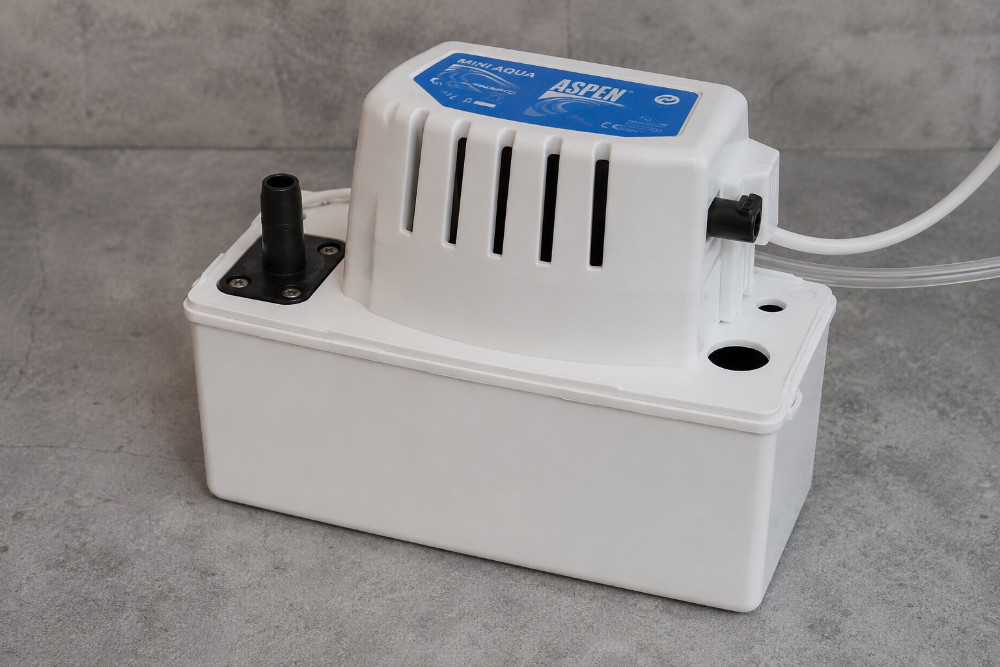
The system can operate based on two fundamental principles. In the case of gravity drainage The drainpipe slopes all the way to the end, so the water drains on its own. For pump-based solutions A condensate pump conveys the water where there is insufficient slope or where the water needs to be lifted. A siphon is often installed at the end of the pipe or along its route to prevent odors and air from flowing back from the sewer.
What solutions are available for draining condensation?
The installation site determines which solution is most appropriate. The table below summarizes the most common options:
| Solution | When is it recommended? | Main advantage | Main disadvantage |
|---|---|---|---|
| Gravity Drainage | If an adequate gradient can be ensured along the entire route | It's simple, requires no electricity, and has few potential sources of error | It only works on a slope; it's difficult to implement in the long run |
| Condensate pump | If there is no slope, or if the water needs to be raised | Flexible routing, concealed installation | Requires electricity, has moving parts, and requires maintenance |
| Condensate atomizer | For certain systems, connected to the outdoor unit | The water is atomized onto the outdoor unit, where it evaporates | Not compatible with all devices; limited capacity |
| Collection tank / collection container | In a temporary or difficult-to-resolve situation | No sewer connection is required | Requires regular manual emptying |
In many cases, solutions are combined: for example, an air conditioner condensate collection tank and a pump work together to handle drainage in situations where neither would be sufficient on its own.
How does an air conditioner without an outdoor unit handle condensation?
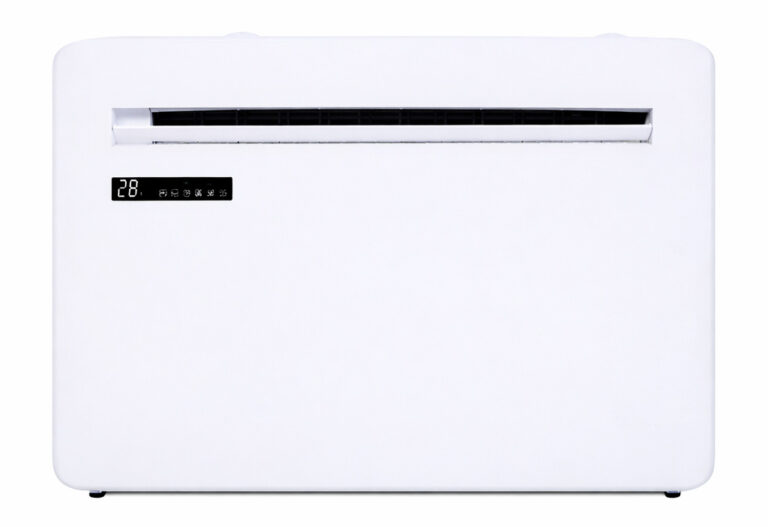
Most of the solutions listed above apply to traditional split-system air conditioners with an outdoor unit. Units without an outdoor unit However, condensation is handled differently in these cases, so it’s worth discussing them separately:
- Portable air conditioner: Condensate typically flows into an internal collection tank, which must be emptied manually, or it can be drained outdoors or into a drain via a drain hose. Many models also partially evaporate the moisture along with the outgoing warm air.
- Monoblock air conditioner (wall-mounted, without an outdoor unit): Condensate often evaporates on its own or is released outdoors through a small outlet, so a separate drainage system is not always necessary.
- Window Air Conditioner: Condensation usually collects on the back of the unit, on the exterior side, and drips out into the open from there.
For these types of units, the most common steps are to empty the collection tank regularly or to ensure that the drain hose is properly installed. If you are unsure how a particular unit handles condensate, it is a good idea to consult a professional.
Take a look at our air conditioning special offers and request a free on-site assessment!
What should we look out for with concealed or ducted air conditioning systems?
Concealed indoor units (those built into walls, suspended ceilings, or cabinets, as well as duct-type air conditioners) require special attention with regard to condensate. These are often installed in locations where it is difficult to ensure a consistent slope, and where a potential leak may not be immediately visible.
- A pump-based solution is often required: Since concealed units often do not allow for a sufficient slope, condensate drainage is typically handled using a condensate pump.
- The leak is hard to detect: In the case of units concealed behind a suspended ceiling or cladding, water may first soak into the structure before any visible signs appear; therefore, prevention and regular inspections are particularly important.
- Maintenance access: It is a good idea to include an access panel during the design phase so that the collection tray, siphon, and pump remain accessible for cleaning later on.
For concealed or ducted air conditioning systems, professional installation and regular maintenance are therefore particularly recommended, because a neglected drain in the flooring or suspended ceiling can cause damage that is difficult to repair.
Where can the condensate from the air conditioner be drained?
Condensate from an air conditioner can be drained to several different destinations. The choice depends on the location, the building’s characteristics, and local regulations:
- Sewer: through a siphon, preventing odors from flowing back.
- Rainwater drainage or catch basin: where this is permitted and technically feasible.
- Outdoor ground level: drained away from the facade so that it does not soak the wall or the foundation.
- Collection container: in places where there is no direct connection available.
It is important to ensure that condensate does not flow onto neighboring property, onto public sidewalks, or into any area where it could cause damage. To select the correct discharge point, it is advisable to request an on-site survey.
How much does it cost to install an air conditioner condensate drain?
An exact price can only be provided once the specific location is known, because the design of the drainage system depends heavily on the site conditions. The price is typically influenced by the following factors:
- The length of the drainage system and the complexity of its route.
- Is a gravity-fed or pumped solution required?.
- The necessary wall drilling, chiseling, and restoration of the wall covering.
- The quality of the materials used (drain pipe, siphon, pump).
- Integration into an existing system or a completely new installation.
- Accessibility of the work area (floor, facade, hard-to-reach locations).
Together, these factors determine the final amount; therefore, a detailed quote based on an on-site assessment is always more accurate than a general estimate.
Common Misconceptions About Air Conditioner Condensate Drainage
- „Draining the condensate is irrelevant.” In fact, improper drainage can lead to water leaks, mold, and appliance malfunctions.
- „The condensate from the air conditioner is safe to drink.” No, it isn't. Although it is similar to distilled water, it can pick up impurities and bacteria from the tray and the tube.
- „Every air conditioner needs a pump.” If there is adequate slope, gravity drainage is sufficient.
- „The condensate drain pipe never gets clogged.” It can become clogged due to algae, dust, and deposits, so it needs to be cleaned from time to time.
- „Water dripping from the outdoor unit is always a sign of a problem.” In certain systems, outdoor condensation is normal, but indoor leaks are not.
Frequently Asked Questions (FAQ)
The most common causes are a clogged or improperly sloped drain pipe, or a full or misaligned drip tray. In such cases, the condensate cannot drain properly, so it leaks from the indoor unit. Cleaning the drain pipe or correcting the slope usually resolves the problem.
Yes, connecting to the sewer is a common solution, but it must be done via a trap to prevent odors from backing up. Local regulations must also be taken into account during installation.
A condensate pump is required when a continuous slope cannot be maintained along the pipeline, or when the water must be lifted to the end point. The pump allows for more flexible installation, but it requires electricity and maintenance.
The frequency of cleaning depends on usage and the environment, but it is recommended to check the system as part of regular air conditioning maintenance. Preventing clogs is the most effective way to avoid leaks.
No. Although its composition is similar to that of distilled water, it may pick up impurities and microorganisms from the collection tray and the piping system, so it is not suitable for consumption.
The amount is not constant: it depends primarily on the humidity of the air and the cooling capacity. Significantly more condensation forms in humid weather than in dry conditions.
Portable, monoblock, and window air conditioners do not use the traditional split-system drainage method. Portable air conditioners typically collect water in an internal reservoir, which must be emptied or drained through a hose. Monoblock and window air conditioners often evaporate the condensate themselves or discharge it outdoors.
Concealed, recessed, or ducted indoor units often lack sufficient slope, so drainage is typically handled using a condensate pump. Since any leaks are difficult to detect, professional installation, easy access for maintenance, and regular inspections are of paramount importance here.
Request an on-site assessment to ensure proper drainage
Properly designing the condensate drainage system for your air conditioner is the key to long-term, trouble-free operation. If you’re unsure whether gravity drainage or a pump is the right solution, request a free on-site assessment from us. Our experts will recommend the best solution based on the conditions at your location and provide you with an accurate quote. Please contact us at Contact on the page.


 English