


Introduction
Monoblock air conditioning is becoming increasingly popular among those looking for a quick-to-install air conditioning solution without an outdoor unit. They are particularly well suited for use in buildings where façade installation is not permitted or desirable. The following article describes what is known as a monoblock air conditioner, its advantages and disadvantages, and the rooms in which it is recommended for use.

What is monoblock air conditioning?
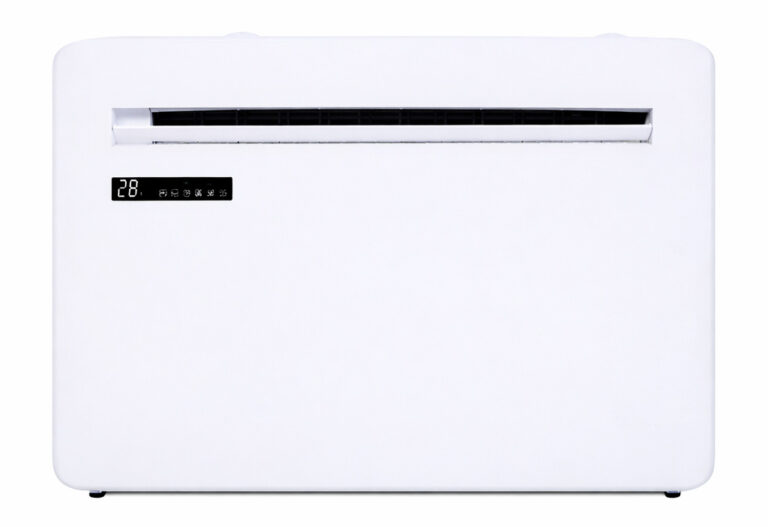
A monoblock air conditioning air conditioning equipment in which all the elements of the refrigerant circuit are contained in a single indoor unit. The unit discharges the warm air to the outside environment through two ducts through the wall, thus no outdoor unit installation required.
How does a monoblock air conditioner work?
The principle of operation is similar to that of split air conditioners, the difference lies in the construction. The unit:
- the air in the room is sucked in,
- cool or heat (depending on the model),
- and then return him to the room,
- and the heat generated ductwork through two walls out into the open air.
It is important to know that there is no separate outdoor unit, so no refrigerant piping outside the wall, which is a key issue for many buildings (e.g. listed buildings, condominiums, city centre apartments).
When is monoblock air conditioning the ideal choice?
This type of climate is mainly for special situations provides a solution. It's worth thinking about if:
- condominium rules prohibit outdoor units,
- the facade of the building is protected as a historical monument,
- no suitable space on a balcony or wall for an outdoor unit,
- fast, easier installation is needed,
- an aesthetic, „invisible” exterior solution is important.
Monoblock air conditioners are particularly popular offices, city centre apartments, commercial premises and holiday homes, where installation constraints make other types of climate unacceptable.
Take a look at our air conditioning special offers and request an on-site assessment!
The benefits of monoblock air conditioning
1. No outdoor unit
This is one of the biggest advantages. There are no permits to obtain, it does not spoil the appearance of the building and there is no source of noise on the facade.
2. Simplified installation
The installation in general:
- Requires 2 wall penetrations,
- no on-site refrigerant charge,
- can be done in less time.
This is often cost savings is also an advantage when installing.
3. Clean interior design
Modern monobloc air conditioners are designed specifically for the home: slim housing, discreet appearance, often with a premium finish.
4. Heating option
Several models can also heat by heat pump, making it an efficient alternative to conventional heating in transitional periods (spring, autumn).
How is it different from a split air conditioner?
A quick comparison:
- Monoblock air conditioning: one unit, without outdoor, through-wall heat dissipation
- Split air conditioning: separate indoor and outdoor units, connected by piping
In monoblock air conditioning performance in general for smaller rooms is ideal, but can also be used where split air conditioning is not.
Who is it best for?
This type of air conditioner can be an ideal choice:
- For rooms of 15-35 m²,
- for owners of flats in the city centre,
- offices, surgeries,
- for customers looking for a no-compromise solution without an outdoor unit.
Disadvantages and limitations of monoblock air conditioning
Although this type of air conditioner is ideal in many cases, it is important to be aware of the with its limitations, to make the choice with realistic expectations. This is not a weakness, but a conscious choice.
1. More limited power
Monoblock air conditioners are typically with lower cooling and heating capacity than split systems. Therefore, they are primarily:
- in smaller apartments,
- for air conditioning a single room,
- in well-insulated properties
were offered.
A common question: Cooling down an entire apartment? Answer: No. A monoblock air conditioner can effectively air condition a room.
2. Higher noise levels indoors
As all components are located in the same housing, the compressor works indoors. Modern appliances are considerably quieter, but:
- for bedrooms is recommended only with caution,
- for noise-sensitive users, it is important to check the decibel level.
On average, you should expect noise levels of 35-45 dB, depending on the type and mode of operation.
3. The need for a wall break
For the installation of monoblock air conditioning in general:
- 2 wall breaks of 160-200 mm diameter are required,
- these are sealed on the outside by grille vents.
This is usually aesthetically manageable, but for thick walls, especially in hard structures, it can be more costly to build.
Energy efficiency and consumption
The energy efficiency of monoblock air conditioners has improved a lot in recent years, but it is still true that:
- their consumption is usually slightly higher, than a split air conditioner of comparable performance,
- efficiency depends strongly on the thermal insulation of the building.
What can we expect in practice?
- Energy class: typically A-A+
- Average consumption: 0.7-1.2 kWh for cooling
- Heating mode: optimised for transitional periods
A common question: More expensive to run? Answer: Yes, it may be slightly higher, but with shorter running times and good insulation, it's not a significant difference.
Installation: what to prepare for in advance?
Monoblock air conditioning is easier to install than a split system, but it is not completely „drill-free”. It is important before installation:
- choosing the right wall (external boundary wall),
- checking the wall thickness,
- providing an electrical connection.
How long is the installation?
Usually 3-5 hours, depending on site conditions.
Need a licence?
In most cases no condominium licence required, as there is no outdoor unit on the facade.
When is monoblock air conditioning not recommended?
This is not the ideal choice if:
- a room with a large floor area (over 40 m²) needs to be cooled,
- we want to air condition several rooms at the same time,
- would be used as the primary heating solution,
- extreme quiet operation is the expectation.
Comparison of monoblock air conditioning with other solutions
To choose the right type of air conditioning, it is worth briefly comparing monoblock air conditioning with the most common alternatives.
Monobloc air conditioning vs. mobile air conditioning
Although at first glance they appear similar, there are significant differences between the two solutions:
- Monoblock air conditioning: wall mounted, permanent installation, improved efficiency, aesthetic appearance
- Mobile air conditioning: rolling design, temporary solution, higher noise and consumption
The monoblock climate in the long term more comfortable and efficient, while a mobile air conditioner is more for occasional use.
Monoblock vs. split air conditioning
Split air conditioning is superior in performance and efficiency, but cannot be installed in all properties.
- Split air conditioning advantage: more power, quieter indoor operation
- Advantage of monoblock air conditioning: no outdoor unit, simpler permitting
If it is not possible to install an outdoor unit, a monoblock air conditioner is often installed in the the only real alternative.
How to choose a monoblock air conditioner?
To choose the right device, consider the following aspects:
1. Room size
General policy:
- 15-25 m²: 2.0-2.5 kW
- 25-35 m²: 2.5-3.0 kW
Too little power is not cooling properly and too much will unnecessarily increase consumption.
2. Noise level
For living spaces, especially bedrooms:
- choose a model with a low noise level (around 35-40 dB),
- pay attention to the presence of the night mode.
3. Features and extras
Modern monobloc air conditioners already offer a range of comfort features:
- heating mode,
- timing,
- remote control or smart control,
- dehumidification function.
Frequently asked questions about monoblock air conditioning
How efficient is monoblock air conditioning?
It is a well-insulated, highly efficient solution for smaller rooms.
Can it be used for heating in winter?
For a temporary period, yes, but not ideal for permanent winter heating.
How visible is it from the outside?
Only two discreet ventilation grilles appear on the façade.
What is the life expectancy?
8-12 years with proper maintenance.
Summary
A monoblock air conditioner can be the ideal solution for those who:
- not install an outdoor unit,
- want to effectively air-condition a single room,
- are looking for an aesthetic and durable solution.
Although not a substitute for split air conditioning in all cases, in some environments the best uncompromising choice.

 English